Your numbers (monthly unless marked)
The question usually arrives as a sentence over dinner: "I think I'm going to quit." Sometimes there's a business idea behind it, sometimes a job that has worn someone down, sometimes a parent or a small child who needs more time. Whoever says it, the person who keeps working is often the one doing the arithmetic afterwards, late at night, on their own.
That person is a woman more often than it used to be. Pew Research Center's 2026 analysis of US Census data found that the share of marriages in which the wife is the primary or sole earner has roughly tripled over 50 years, to 16%.
The calculator starts with an illustrative couple. Dana takes home $5,200 a month. Her husband takes home $3,400 and wants to leave his job to start a garden design business. Rent, utilities, insurance and phones come to $3,100; car and card payments, $350; food, fuel and everything else, $1,700. They put $400 a month toward retirement. His commute and lunches cost about $300 a month, and moving the family's health cover to Dana's employer plan would add roughly $600. On Dana's pay alone they're $650 short every month. Their $15,000 cash set aside covers that for about 23 months, and a 12-month trial leaves $7,200 of it. Replace her numbers with yours.
What the one-income budget often leaves out
- Health cover (US). If the family is insured through the job that stops, someone has to replace it. KFF's 2025 survey put the average annual premium for employer family cover at $26,993, of which workers paid $6,850 on average (about $570 a month). COBRA lets you keep the old plan for a limited time, but the US Department of Labor notes you may have to pay the whole premium, up to 102% of the plan's cost. Get the real quote before deciding.
- Retirement for the person who stops. In the US, a spouse with no earnings can still contribute to an IRA if you file a joint return and the working spouse has enough taxable compensation. The IRS limit for 2026 is $7,500 each, or $8,600 at 50 and over. In the UK, the State Pension depends on qualifying years on your National Insurance record; you need 10 to get any new State Pension. Check the forecast of whoever is stopping, and whether credits (for example as a parent or carer) or voluntary contributions apply.
- Tax that changes (UK). If the person at home earns less than the Personal Allowance (usually £12,570) and the other pays basic-rate tax, Marriage Allowance lets you transfer £1,260 of allowance, which cuts the earner's tax by up to £252 a year. Higher-rate taxpayers don't qualify.
- Costs that go up when someone is home. Heating and electricity during the day, lunches at home, and in a new business, equipment and insurance. Put them in "new costs".
Run it for three months before anyone resigns
"Live on one income and bank the other" is common enough advice that it turns up in Google's own suggestions for this question. It's worth trying because it tests the number that's hardest to know in advance: what you really spend when only one paycheck lands.
- Pick a start date and a separate account for the second paycheck.
- For three months, pay every bill and every grocery shop from the continuing pay only.
- At the end, compare what you actually spent with the calculator's monthly cost line.
- If you went over every month, change the plan before the paycheck stops, not after. If you stayed under, you start with three months of the second paycheck already set aside.
When it's their plan and your paycheck
On Reddit's r/AskWomenOver30 in October 2026, a teacher asked how to handle resentment after years in which her husband's career risks had rested on her steady job. The arithmetic was only part of what she was asking about.
A plan you've both agreed is easier to carry than one you've absorbed. Before the start date, agree:
- How long the trial runs, and the date you'll sit down and look at it again.
- The number that triggers a rethink, for example when the cash left would cover fewer than three months of the shortfall.
- Who does which household jobs now that one of you is home more. Time at home doesn't move housework on its own. The hand-off card planner helps you write down who now owns what.
- Whose name the retirement contributions go in, so the person at home isn't left with a gap later.
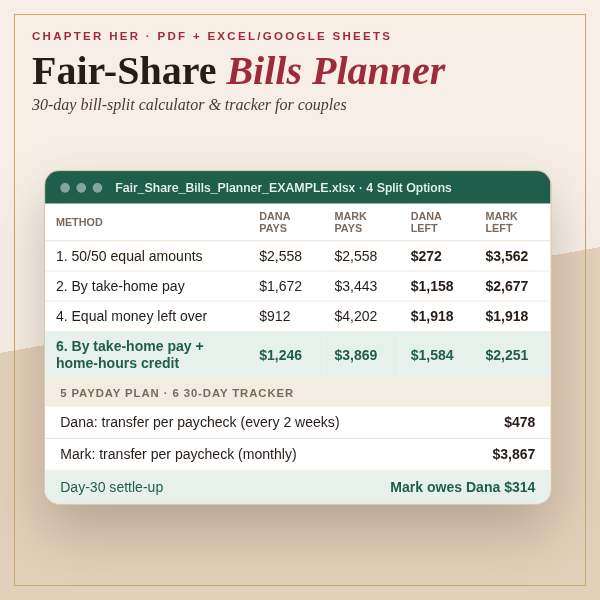
The 30-Day Fair-Share Bills Planner for Couples With Different Incomes
What's inside: A 23-page PDF guide and a 9-tab Excel / Google Sheets planner: six ways to split shared bills side by side, what each one leaves each of you, and per-paycheck transfers.
Who it's for: For couples with different incomes who share household bills.
Educational only, not financial advice. Digital download via Gumroad checkout.
Questions people ask
How much do you need to live on one income?
There isn't one figure. What matters is whether your monthly costs on one income fit inside the take-home pay that continues. Use take-home pay, not salary, and use real bank statements for everyday spending.
Should we live on one income and bank the other first?
If you can, it's one of the most useful tests available, because it shows what you really spend before anything is final. Three months also gives you a better chance of catching an irregular bill, such as a quarterly one.
What if one of us goes part-time instead of stopping?
Put the combined pay you'd still have in 'take-home pay that continues' and the drop in 'pay that would stop'. If your incomes end up very different, the couples bill split calculator shows several ways to share the bills.
Does this work in pounds?
Yes. Switch the currency to £. The health cover and IRA notes are US-specific; the Marriage Allowance and State Pension notes are UK-specific.
Sources
- Pew Research Center (22 Oct 2026): Women, work and caregiving through the arc of family life
- KFF: Annual family premiums for employer coverage rise 6% in 2025 (Employer Health Benefits Survey)
- US Department of Labor: Continuation of Health Coverage (COBRA)
- IRS: Retirement topics, IRA contribution limits (incl. spousal IRAs)
- GOV.UK: Marriage Allowance
- GOV.UK: The new State Pension, eligibility and your National Insurance record
- Reddit r/AskWomenOver30 (Oct 2026): resentment when a spouse's career risks rest on your steady job
Keep going
What does cutting back for care really cost?
Estimate the pay and pension contributions you'd give up by cutting back for care.
An emergency fund for the sandwich years
Size an emergency fund that includes help you might give a parent at short notice.
How long could you step away?
Work out how many months your savings would last if you took a break to change direction.